
Gem County Scheduled vs Actual Release
Idaho public systems use several date labels. A Parole Eligibility Date, or PED, is the earliest ordinary point for parole consideration under the sentence. A Next Parole Hearing Date schedules Commission review. A tentative parole date is conditional and can change. Sentence Satisfaction Date is the endpoint shown for a sentence row. Released to Supervision is different again: it records a past placement in the community.
A pretrial detainee at Gem County Jail has no sentence-based projected release date. Release may depend on bond, recognizance, dismissal, a later court order, transfer, or another hold. A sentenced county inmate requires the judgment, booking date, jail credit, local time computation, and hold check. IDOC dates should not be borrowed for a jail-only sentence.
Find Gem County Projected Release Dates
The IDOC Resident/Client Search accepts a name or IDOC number and is updated daily. It does not label a general field Projected Release Date. The demonstrated forward-looking fields are PED and Next Parole Hearing Date, while sentence rows can show Sentence Satisfaction Date.
- Identify the holding system through the Gem County release search. A jail case and an IDOC sentence require different records.
- For IDOC custody, search by IDOC number when known. Otherwise match name, age, sentencing county, offense, and case number.
- Copy each date with its exact label and the date checked. Do not rename PED as release.
- Read the judgment for fixed and indeterminate terms, concurrent or consecutive structure, and jail credit.
- Check the Commission source if a parole hearing or tentative action matters.
- After the proposed date, confirm actual placement through IDOC status, physical location, and Released to Supervision.
The official example result below shows why labels matter.
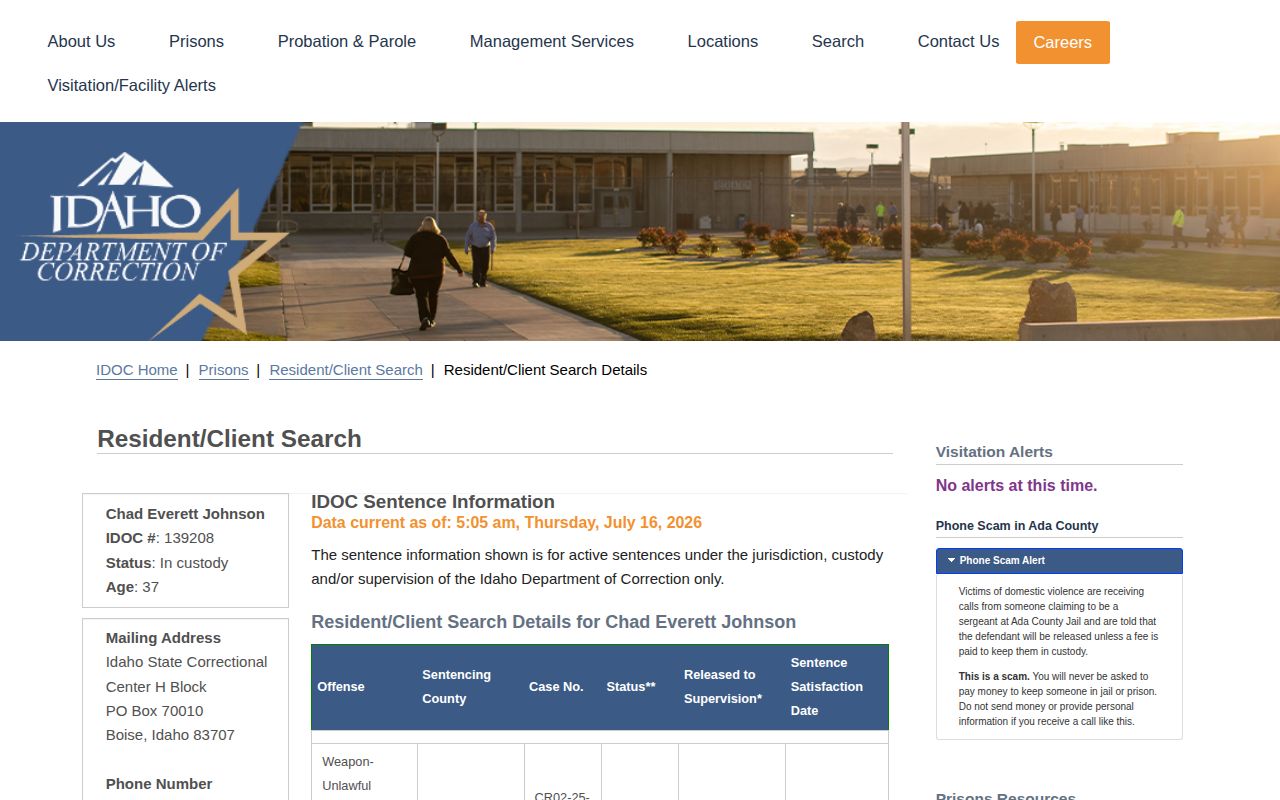
The image demonstrates parole-related dates, not a guaranteed day of departure.
Idaho Fixed Terms and Credits
Idaho Code § 19-2513 creates a unified sentence. The court sets a minimum period of confinement, called the determinate or fixed portion, and may add an indeterminate portion. During the minimum term, the person is not eligible for ordinary parole or discharge and does not receive a general good-conduct reduction. The statute contains narrow references to meritorious service under § 20-101D and medical parole under § 20-1006.
Idaho should not be described with a universal 85-percent formula. No such calculation is supported by the governing state source. The fixed term, mandatory minimums, consecutive sentences or enhancements, credited jail time, lawful sentence changes, and narrow statutory exceptions can all affect the timeline. A sentence consisting only of a fixed term, or life without parole, has no ordinary indeterminate parole window.
The Commission FAQ explains that PED marks entry into the indeterminate portion and is only the earliest possible parole. Multiple sentences can change the controlling date. Exact arithmetic belongs to the judgment and IDOC time-computation record, not a calculation made from a short description of the sentence.
Why Gem County Release Dates Change
Even a correctly labeled date can move. The cause should be tied to an official record rather than inferred from a missing name or old calendar.
| Factor | Possible effect | Confirm with |
|---|---|---|
| Amended judgment or appeal | Changes the sentence basis | Gem County court order |
| Jail credit or recalculation | Changes time computation | Jail or IDOC records |
| Consecutive sentences | Moves the controlling date | Judgment and IDOC calculation |
| Detainer or new custody | Prevents community release | Holding agency |
| Parole denial or deferral | No release on the expected path | Commission action |
| Programming or plan approval | Delays a tentative parole placement | Commission and IDOC |
A parole grant still may require programming, an investigated and approved plan, transport, and final paperwork. A rejected plan can be revised. Therefore, even a tentative date from an official decision does not establish that the person walked out of prison.
Confirm Gem County Actual Release
For state custody, check IDOC after the expected date. Look for overall In community status, the physical location, sentence status Parole where applicable, Released to Supervision, and the listed district. Read all fields together. If the location still names a facility or jail, call that agency and the supervision district before stating that release occurred.
The VINELink Inmate Search can provide custody-change notices when a participating agency supplies an event, but it is not the judgment or release sheet. For Gem County Jail, call 208-365-4484 and ask whether the person was released to the community or transferred. Request the release record when the exact time, type, or destination is needed.
For county records, ask Sheriff's Records for an existing booking or release sheet and give the full name, date of birth if available, booking date, and case or booking number. For IDOC history, use Records Information and specify the IDOC number and exact time-computation, release-to-supervision, or discharge record sought.
Gem County Parole Hearing Dates
The Commission hearing schedule is the source for planned hearings. Dates and times can change. A hearing date means the case is set for consideration, not that parole has been granted. If Section 17 is relevant to the person, read the later Notice of Action Taken and retain its exact outcome language.
The Commission may report a grant with a tentative date, denial or pass, reconsideration, continuance, or another action. Do not reduce every result to granted or denied. After any tentative date, return to IDOC to confirm the person's status and Released to Supervision.
Gem County Jail Date Records
A county-jail date starts with a different file set. Obtain the signed judgment or release order, the booking date, any jail-credit entry, and the jail's own time computation. Ask whether a warrant, detainer, transfer order, or separate case keeps custody in place. The public Gem County pages inspected do not publish a local good-time formula, weekend or holiday adjustment rule, or property-release schedule. Exact-date questions therefore belong with the jail and court, not an unsourced calculator.
A release order can explain legal authority without proving that physical release has happened. Staff may still need to process paperwork, check holds, arrange a transfer, or complete another lawful step. Conversely, a person can leave Gem County Jail by transfer while remaining in custody. Use the words released to the community only after the source supports that event, and use transferred when another agency took custody. Record the source and time of each confirmation.
For documentary proof, request an existing jail register entry, booking and release sheet, or database record. Include the name, approximate booking window, case number, and preferred electronic format. Idaho agencies generally need not create a new record or calculate a date merely to answer a question. A narrow request is more likely to locate the exact entry and avoid unrelated protected material.
Read Idaho Release Date Labels
Four forward-looking or historical labels must remain separate. Parole Eligibility Date is the earliest ordinary parole-consideration point created by the sentence structure. Next Parole Hearing Date identifies a planned review. A tentative parole date is a conditional Commission date that can change. Sentence Satisfaction Date is the full-term endpoint for the sentence row. Released to Supervision is historical evidence that community placement occurred.
The public IDOC detail design does not provide one general field named projected release date. Copy each official label exactly and note when the record was checked. IDOC warns that its database updates daily but can change fast and may not show the newest location, status, scheduled termination date, or other information. An exact-looking date should not erase that update warning.
Gem County Unified Sentences
Idaho's unified-sentence structure combines a determinate, or fixed, portion with a possible indeterminate portion. The court judgment controls both parts. During the fixed term, ordinary parole or discharge is unavailable. Parole consideration generally begins with the indeterminate portion, subject to statutory exceptions. For multiple sentences, concurrent or consecutive structure can change which date controls.
A news account that reports only the total sentence may omit the fixed term, jail credit, enhancements, or another consecutive case. It is therefore not a safe basis for date arithmetic. Obtain the Gem County judgment and IDOC time-computation information. If the sentence has only a fixed term, or is life without parole, there is no ordinary indeterminate parole window to calculate.
Before Idaho Parole Release
A favorable Commission action may still leave several steps. Required programming can remain incomplete. IDOC must investigate and approve the parole plan. Transportation, a final contract, and release paperwork must be arranged. A rejected plan can be corrected and submitted again. Each step can prevent a tentative date from becoming the day the person physically leaves.
The Commission's Notice of Action Taken should be quoted by its actual outcome type. Results can include a grant with a tentative date, denial or pass, reconsideration, continuance, or a revocation-related action. Do not normalize all actions into granted or denied. After the date, IDOC status and Released to Supervision provide the better confirmation of community placement.
Gem County Date Source Order
For a jail sentence, start with the signed court judgment and the jail's calculation. For state imprisonment, use the judgment, IDOC detail, and Commission action together. When a detainer or transfer is possible, contact the agency shown as the physical location. VINE may provide a custody-change notice, but it does not replace the time-computation record or judgment.
If two sources disagree, compare identifiers, source dates, and jurisdiction before drawing a conclusion. A court order can authorize release while processing remains underway. An IDOC status can lag a new county hold. The accurate answer may be limited to the date label currently displayed and the conflict that still requires agency confirmation.